Walk the floor of an OTAKUKON Anime Festival event and you’ll see it before anyone tells you. Behind the cosplay, the queues at the gaming stations, and the crowd three-deep at the manga booth, there is a quieter thing happening at the artist tables. A young creator sitting behind a stack of hand-assembled pages. A sketchbook full of a world nobody has published yet. A first chapter that will, if we’re honest, probably never see a second. That last part is the reason ARM Comics exists.
The Gap ARM Comics is Filling
Zimbabwe does not have a talent problem. We have spent any time in the OTAKUKON and general artist ecosystems and that became obvious fast. What we have, what much of the continent has, is a continuity problem.
We have artists who can draw. We have writers with genuinely original worlds. What we have far less of is the machinery that lets a talented person turn one brilliant idea into a running body of work: an editor to push a script from good to great, a printer who can produce a clean book at a price real readers will pay, and a route to actually put that book in someone’s hands. Without those things, even the best creators stall out after a single ashcan or a lone issue. The story gets born and then, for the most simple and unfair reasons, it doesn’t get to grow up.
ARM Comics came directly out of watching this happen, year after year, at close range. We kept meeting creators with the hardest part already solved, the imagination. In Zimbabwe we were losing them to the parts that should have been the easiest: printing, editing, distribution. The insight underneath everything we do is that simple. The stories are already here. The infrastructure isn’t. So we decided to build the infrastructure.
Fundamentally, ARM exists to give these stories a place to be born — and, just as importantly, a place to keep coming back.
Where this comes from
ARM Comics is the work of Archie Moyo, and it doesn’t come out of nowhere.
Archie is the founder of OTAKUKON Anime Festival, Zimbabwe’s largest anime and comic convention, along with two other homegrown pop-culture events, Nakamarket and Button Bash. That’s years of building the rooms where Zimbabwe’s geek and creator community actually shows up; the stages, the artist alleys, the marketplaces where a local creator can sell a book face-to-face to a reader who’s been waiting for exactly that book.
Building those rooms is what made the gap impossible to ignore. When you spend a decade creating the platforms where artists get discovered, you also become the person who sees, more clearly than anyone, what happens after the discovery. The moment a creator with a great chapter has no editor to call, no affordable printer to trust, and no distributor beyond the one day of a festival weekend. ARM is the natural next step: taking a community that already knows how to celebrate comics and giving it the means to publish them, consistently.
The standard we’re aiming for
If you want to understand the level we’re building toward, look at artists like Bill Masuku.
A Zimbabwean comic book artist and writer born in Harare, Masuku is the creator of Razor-Man, Captain South Africa, Welcome to Dead World, and Tokoloshe Hunters. He is currently working on a graphic novel Runeless that will be published through Disney Books. His trajectory since has been extraordinary: work as a storyboard artist on Disney and Kugali Media’s Emmy-nominated animated series Iwájú, a place on the Forbes Africa Under 30 list, a Nommo Award nomination, and Runeless in development for Disney Hyperion through the Kugali Ink imprint. He is, by any measure, one of the most groundbreaking creators this country has produced.
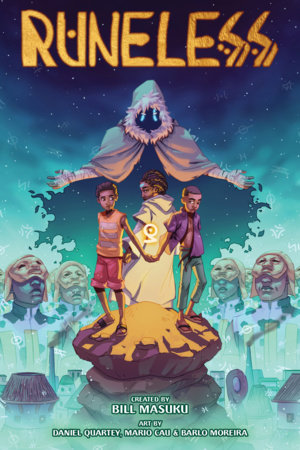
He is also proof of a point we take seriously. Masuku has spoken plainly about the fact that the hardest part of his career has never been the drawing — it’s been distribution: too few stores, a supply chain that lives and dies on the convention circuit, the constant grind of getting African books into readers’ hands. Even a creator of his calibre has had to fight the exact structural gaps that stop so many others before they ever get going.
That’s the point. Bill Masuku is not a miracle. He’s what talent looks like when it finds a way through the infrastructure gap. Our ambition is to make that way through less of an exception — to build the kind of platform where the next Bill Masuku doesn’t have to be uncommonly lucky as well as uncommonly gifted. We want African comics to reach a level of consistency where groundbreaking artists aren’t rare survivors of a broken pipeline, but the natural output of a working one.
The invitation
African comics don’t need permission to be excellent. We feel that for now, our stories just need to be consistent. Readers need to know that a story they pick up today, will have a new issue in a month. We want the stories we are a part of to become a part of young children’s childhoods. Helping each other take stories to that level of consistency is the hardest challenge we have ahead of us. It is a challenge for artists ready to take their work to the next level.
ARM Comics is our attempt to close the distance between the sketchbook and the shelf. If you’re a Zimbabwean or African creator with a world you’ve been carrying around, waiting for someone to help you build it out properly then this was made for you.
Bring us the story. Let’s give it a place to be born.
lIf you’re a creator interested in publishing with us, get in touch — we’d love to see what you’re working on.